Zomato Tiffin
A concept that brings home-style tiffin subscriptions into Zomato, with AI recommendations that plan a week of meals around a person’s budget, diet and routine.
- Type
- Self-initiated concept
- Year
- 2025
- Role
- Solo UX/UI designer, end to end
- Category
- Food delivery · Mobile app concept
- Deliverables
- Survey and persona, User flow, Design system, 15+ high-fidelity screens, Clickable prototype
Self-initiated concept project — not affiliated with, endorsed by or commissioned by Zomato.
Contents
01 — Overview
AI-powered meal planning, inside Zomato
Zomato Tiffin is a self-initiated concept that brings home-style tiffin subscriptions into Zomato, with AI recommendations that plan a week of meals around a person’s budget, diet and routine. I designed it end to end: a survey and persona, the user flow, a design system, 15+ high-fidelity screens and a clickable prototype tested with five people.
- 6 peopleSurveyed, ages 18–50
- 83%Interested in a tiffin meal planner
- 67%Want AI meal recommendations
- 5 usersTested the prototype
02 — Problem & context
Instant delivery is solved. Everyday meals aren’t.
Zomato is one of India’s most widely used food delivery platforms. It excels at instant delivery, but there’s growing demand for home-style, affordable and healthy daily meals — and no easy way to plan them inside the app.
The target users are students, working professionals and people living away from home who need subscription-based homemade meals, known in India as tiffin services. They struggle to find a suitable tiffin service inside food delivery apps because:
- CostFinding affordable tiffin services is difficult
- FatigueChoosing meals every day causes decision fatigue
- FitThere’s no personalisation by diet or budget
- StructureThere’s no structured weekly or monthly meal planning
- NutritionThere’s no nutrition guidance or tracking
- ChoiceThere are too many choices and no smart guidance
03 — Goals & constraints
A trust-based AI meal planner
The solution: redesign Zomato’s tiffin service with AI-powered meal recommendations that help people plan meals around their lifestyle, budget and dietary preferences. The work ran in four steps.
- 1 · DiscoverA survey of 6 people aged 18–50, with 8 questions on habits, interest and AI.
- 2 · DefineA persona, research conclusions and one design direction.
- 3 · DesignA feature breakdown, the user flow, a design system and 15+ screens.
- 4 · TestA prototype tested with 5 users, then four iterations.
Build a trust-based AI meal planner focused on affordability, health and routine.
04 — My role
Solo, end to end
I was the only designer: the survey and persona, the user flow, the design system, every screen and the clickable prototype, then the usability test and the changes that followed.
Tools: Figma for design and prototyping, Notion, Canva and an online survey.
- Survey
- Persona
- User flow
- Design system
- High-fidelity UI
- Prototype
- Usability testing
05 — Research & insights
Research and insights
A short survey checked whether people would use a tiffin planner at all, what they would need from it, and how they felt about AI choosing their meals: 6 participants aged 18–50 answered 8 questions.
83% were interested in a tiffin meal planner — 50% very and 33% somewhat; 17% were not very interested. 67% wanted AI meal recommendations, and budget-friendly meals, nutritional information and AI recommendations were the top requested features.
The findings became a persona — Aarav Mehta, 24, a software engineer in Bengaluru who lives alone with a busy schedule — and six conclusions: people want a tiffin planner, budget matters the most, nutrition tracking is important, monthly plans are preferred, privacy and accuracy are concerns, and AI recommendations are valued. With six people, the findings are directional.
06 — Flows & IA
One flow from sign-in to a planned week
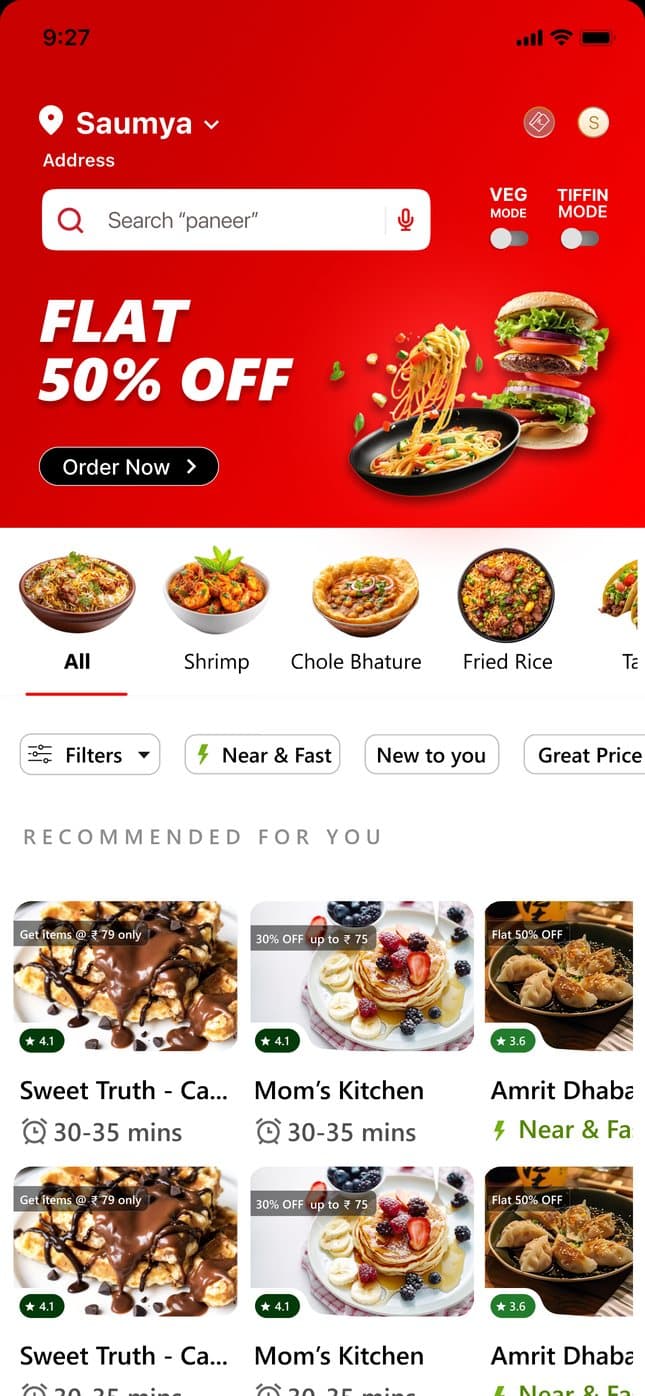
The tiffin experience sits inside Zomato’s existing app: after sign-in and address, the home screen offers three paths, and the tiffin and AI paths meet — “Skip & Choose with AI” jumps from the recommendations straight into the AI planner.
A new user’s journey takes six steps: home, preferences, AI recommendations, the weekly plan, apply plan and checkout. Six features carry it.
- 1 · Tiffin entryA prominent Tiffin shortcut on the home screen makes the service discoverable.
- 2 · Smart meal plannerA welcome screen with an AI option and manual browsing keeps the user in control.
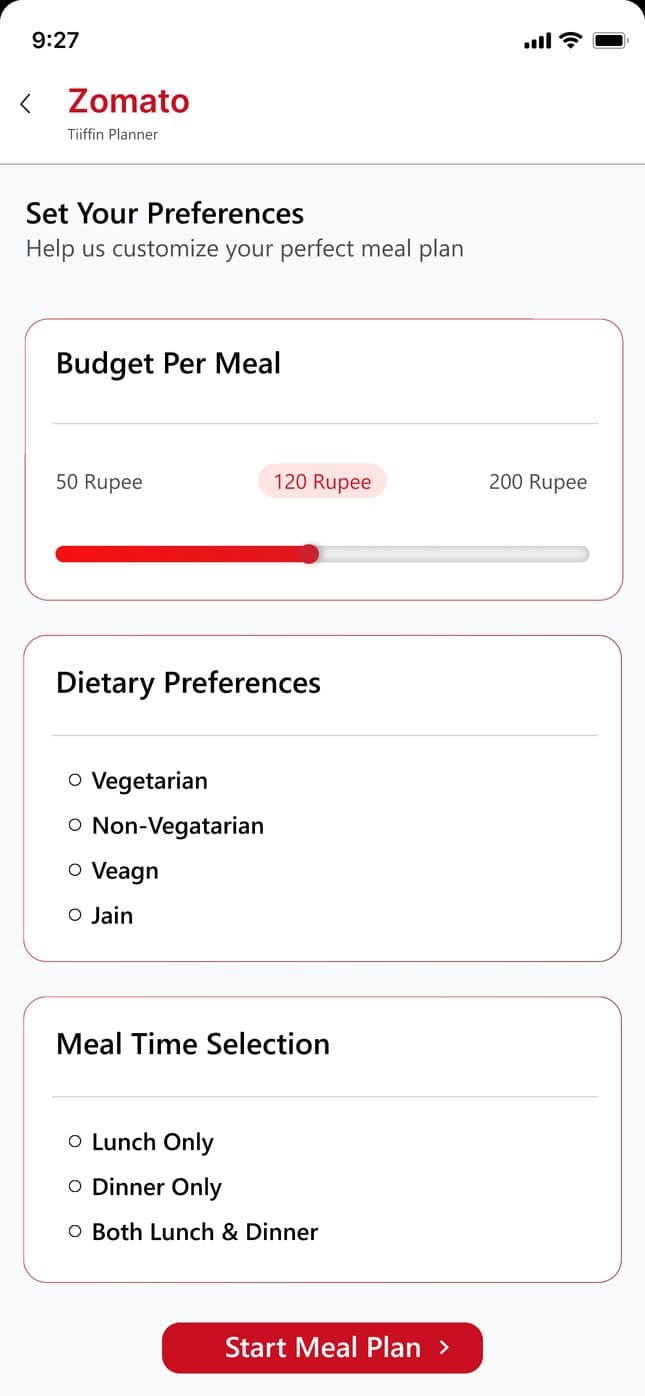
- 3 · Preference setupBudget range, dietary choice, meal timing and cuisine.
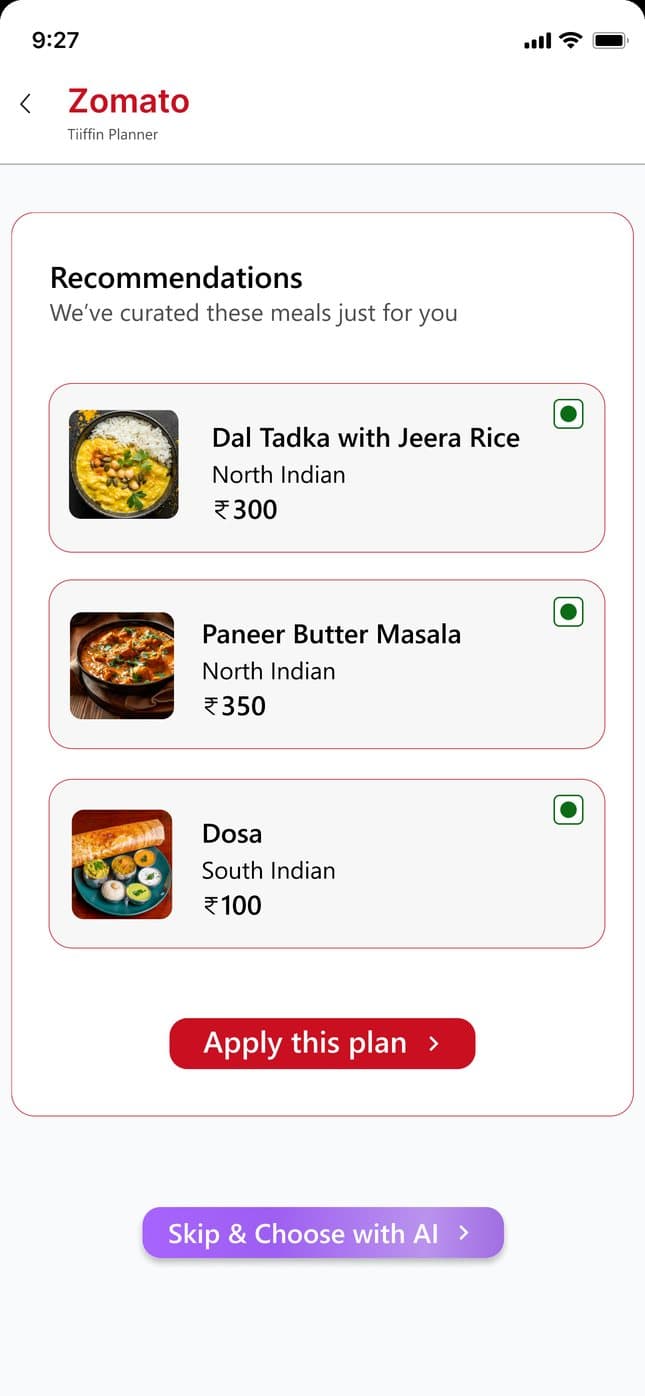
- 4 · AI recommendationsSuggestions based on diet, budget, past orders, time of day and health goals.
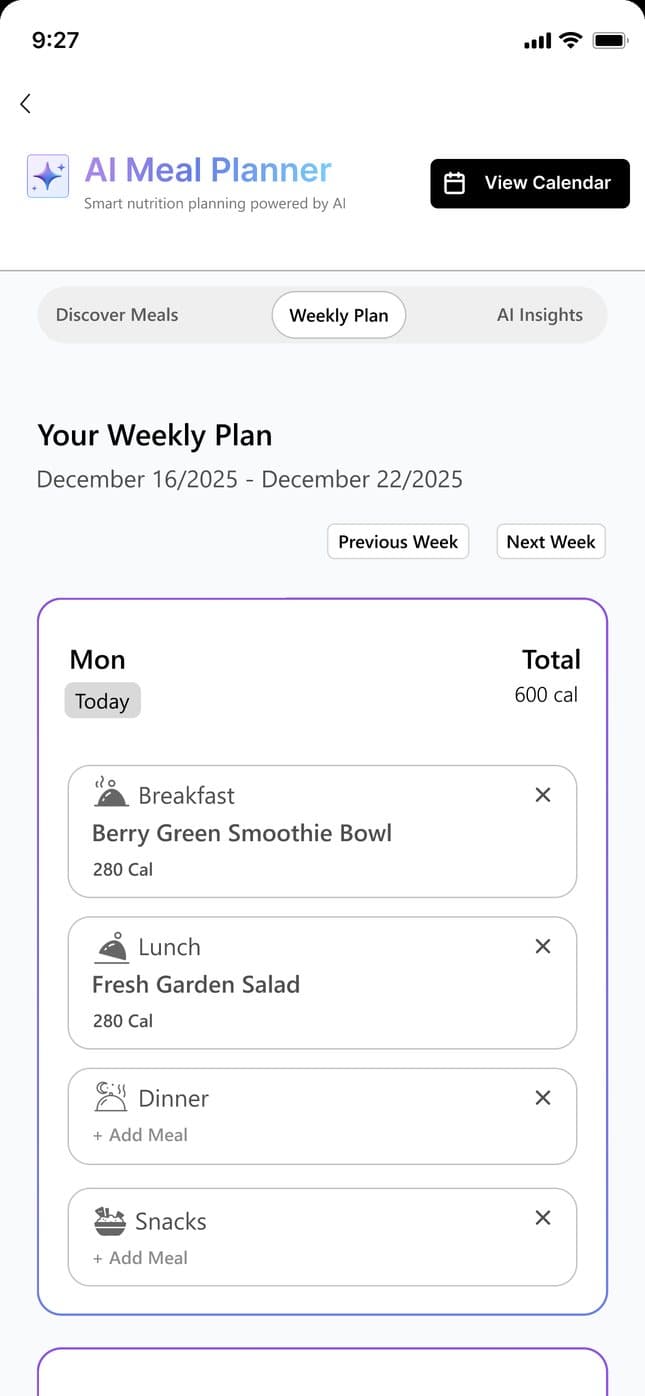
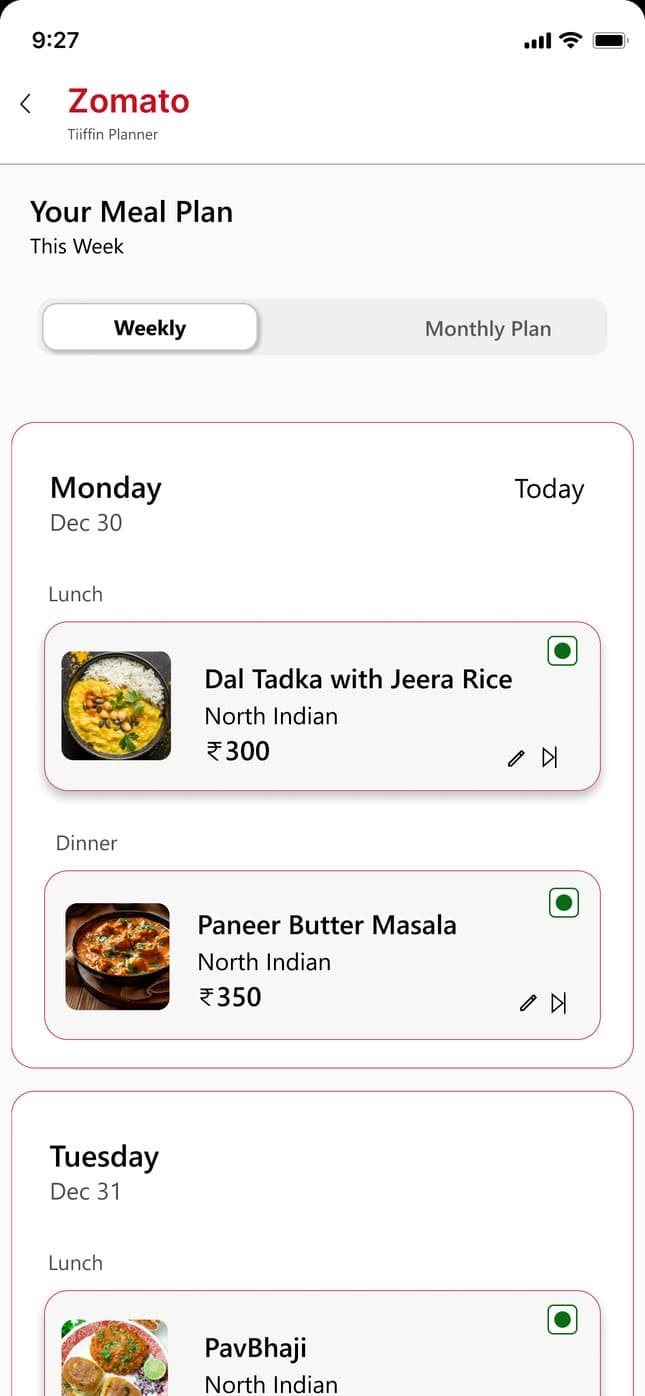
- 5 · Weekly/monthly plannerSee the full week, swap meals, track progress and subscribe to monthly plans.
- 6 · Nutrition dashboardCalories, protein, carbs, fat and progress toward daily goals.
07 — Exploration
Familiar Zomato red, with a clear signal for AI
The concept keeps Zomato’s red and white so it feels native to the app, and adds one purple that marks every AI feature — from suggestion cards to the “Skip & Choose with AI” shortcut — so suggestions are never mistaken for ads.
Seven colours with defined roles and three typefaces — Inter, Domine and Segoe UI — sit under reusable components: promo banners in red, AI cards in purple, segmented tabs, a weekly/monthly toggle and veg-mode switches. Cards carry the data: price, cuisine, calories and macros sit on every meal card for quick comparison.
08 — Final interface
Decisions behind the planner
Each decision traces back to the research, and each has a cost that was accepted on purpose.
- 01 · Tiffin on the home screenA Tiffin shortcut on Zomato’s home, next to the Veg mode toggle, because people struggled to find tiffin services inside food apps. Trade-off: one more element on a busy home screen.
- 02 · AI, with a manual pathThe Tiffin home offers Start Meal Planning, AI suggestions or browsing, because people trust AI more when it’s a choice, not a default. Trade-off: two paths to design and keep consistent.
- 03 · Budget firstPreferences open with a budget-per-meal slider (₹50–200), then diet and meal time — “budget matters the most” was the strongest finding. Trade-off: an extra step before the first recommendation.
- 04 · Price on every suggestionEach recommendation shows the dish, its cuisine and its price, such as Dal Tadka with Jeera Rice, North Indian, ₹300. Trade-off: fewer items fit on one screen.
- 05 · Skip to AI“Skip & Choose with AI” sits under the recommendations — for decision fatigue, the fastest path is letting AI fill the plan. Trade-off: people may skip preferences that improve accuracy.
- 06 · Plan the week, not the mealA weekly planner with breakfast, lunch, dinner and snacks, and a Weekly/Monthly toggle, because people wanted structure and preferred monthly plans. Trade-off: more to manage than a single order.
- 07 · Explain AI with goalsAI Insights give named suggestions — Increase Protein Intake, Stay Hydrated, Meal Prep Sunday — with impact tags, based on eating patterns and health goals. Trade-off: insights need accurate nutrition data to be credible.
- 08 · Let subscriptions pauseThe tiffin path ends in a weekly or monthly plan with Pause Subscription, not only cancel, so routines can change without leaving. Trade-off: more subscription states to handle.
09 — Testing & iteration
Tested with five people, refined four ways
The clickable prototype was tested with five users. They loved the AI suggestions, found the weekly planner helpful and appreciated the clear UI — and they asked for meal reminders.
Four iterations followed: more visible calls to action, an added progress bar, simpler onboarding and better meal labels.
10 — Outcomes & learnings
Tested, refined, and honest about scope
The result is 15+ high-fidelity mobile screens, from sign-in to weekly plans and AI nutrition insights, with a design system and a clickable prototype that opens on the splash screen.
What isn’t claimed: this is a self-initiated concept, not a Zomato release, so there are no launch, adoption or revenue results. Research and testing were small — 6 and 5 people — so the findings are directional.
Next: meal reminders (requested in testing), water tracking, health reports and smart budget tracking.
- AI simplifies decisionsAI personalisation can solve real, everyday decision fatigue.
- Users want guidancePeople prefer curated suggestions over endless browsing.
- Trust > visualsTrust built through accuracy matters more than flashy design.